



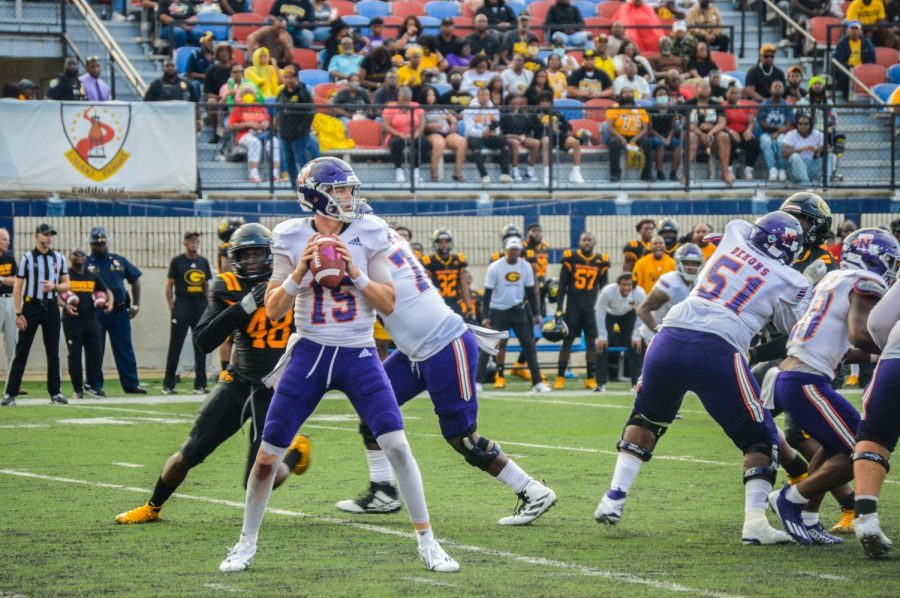









On game day, the spotlight focuses on the athletes, but much of Northwestern State University of Louisiana’s athletic success is built in moments that the fans do not see. At NSU, staff members form the backbone of the athletics department, providing medical care, academic support and structure to ensure student-athletes are supported and able to perform their best.
According to an article by Knack, “Institutions that embrace flexible, accessible, and student-first support models will not only see improved academic outcomes but also stronger student engagement and retention.”
Jason Smelser, director of strength and conditioning, oversees the performance, training and nutrition of NSU student-athletes while managing the university’s strength and conditioning staff.
Smelser is responsible for the performance aspect of Demon football and supervises strength and conditioning coaches for all NSU athletic programs. His role extends beyond the weight room, with nutrition planning, wellness monitoring and sports science playing key roles in the athletic department.
Nutrition is a major component of the performance program. Smelser and his staff help ensure athletes are properly fueled to meet the demands of their sport.
“Through their wellness reports, we monitor their sleep hygiene, hydration and how their body feels to make sure they are performing well,” Smelser said. “We take into account key performance indicators, which are their speed, strength, power and more.”
For most athletic programs, Smelser said training and nutrition plans can be individualized for each athlete. With larger programs such as football, athletes are grouped by position to tailor training and nutrition to the physical demands of their role.
Employed through Natchitoches Regional Medical Center, Kalevi Pajuluoma, director of sports medicine, serves as the primary link between NSU Athletics and the hospital. He oversees orthopedic injuries across all sports and works directly with the Demon football program as its head athletic trainer.
NSU athletics works closely with two orthopedic physicians, Dr. Theodore Knatt and Dr. Theodore Jordan, for injuries that go beyond the sports medicine staff’s capabilities.
“The most common injuries we see in NSU athletes are ankle injuries, hamstring strain and sometimes impingement in the shoulders. We do a range of motion testing to see where there are deficits,” Pajuluoma said.
Pajuluoma explained that his team works with the strength coaches and head coaches to ensure the athletes remain safe and healthy. “If an athlete does get injured, my job is to evaluate it and diagnose it,” Pajuluoma said. “If they have past injuries, we make sure that we are rehabbing those or doing maintenance exercises to prevent more injury.”
Julia Davis, director of enhanced academic programming, is another staff member who plays a key role in helping student-athletes. Davis oversees academic support for soccer, volleyball and both the men’s and women’s track and field programs. She also works closely with student-athletes who require learning accommodations or additional academic structure.
In a study from Taylor and Francis Online, “Student-athletes highlighted academic support staff, access to knowledgeable insiders (such as lecturers and fellow students), as well as study halls and tutoring services, as key structural supports for managing both academic and athletic commitments.”
NSU provides academic support tailored specifically to student-athletes. In addition to campus-wide resources available to all NSU students, student-athletes have access to free tutoring across multiple subjects, a study hall, a computer and printer in the athletic fieldhouse, learning disability evaluations and accommodations and exam proctoring with permission of professors.
“These resources give them a guideline so they are not struggling academically. It lets them know that the staff understands that it is hard being a student-athlete, but we want to help them and see them succeed,” Davis said.
Traveling to away games often causes student-athletes to miss in-person class time. Davis and her staff communicate with professors about absences due to sporting events and help student-athletes with time management during the season.
This balancing act extends beyond athletics and academics, with NSU’s student-athletes often overwhelmed by the demands of their social lives as well, a struggle for many young adults adjusting to the demands of college.
“One of the biggest challenges that student-athletes face is time management,” Davis said.
To address this, Davis meets individually with athletes who are struggling with time management and helps them create realistic schedules that allow them to succeed both in the classroom and in their sport.
Davis also addresses a common misconception about student-athletes. “Student-athletes’ schedules are hard, but we will hold them accountable. Sometimes they just need extra support and thankfully, the university helps provide that support for them,” Davis said.
All NSU Athletics’ staff members play a key role in helping student-athletes succeed both in their sport and in the classroom. While fans see the results on gameday, much of the success is built behind the scenes. NSU athletics relies on a collaborative effort to ensure that student-athletes are supported in every aspect of their college experience.