















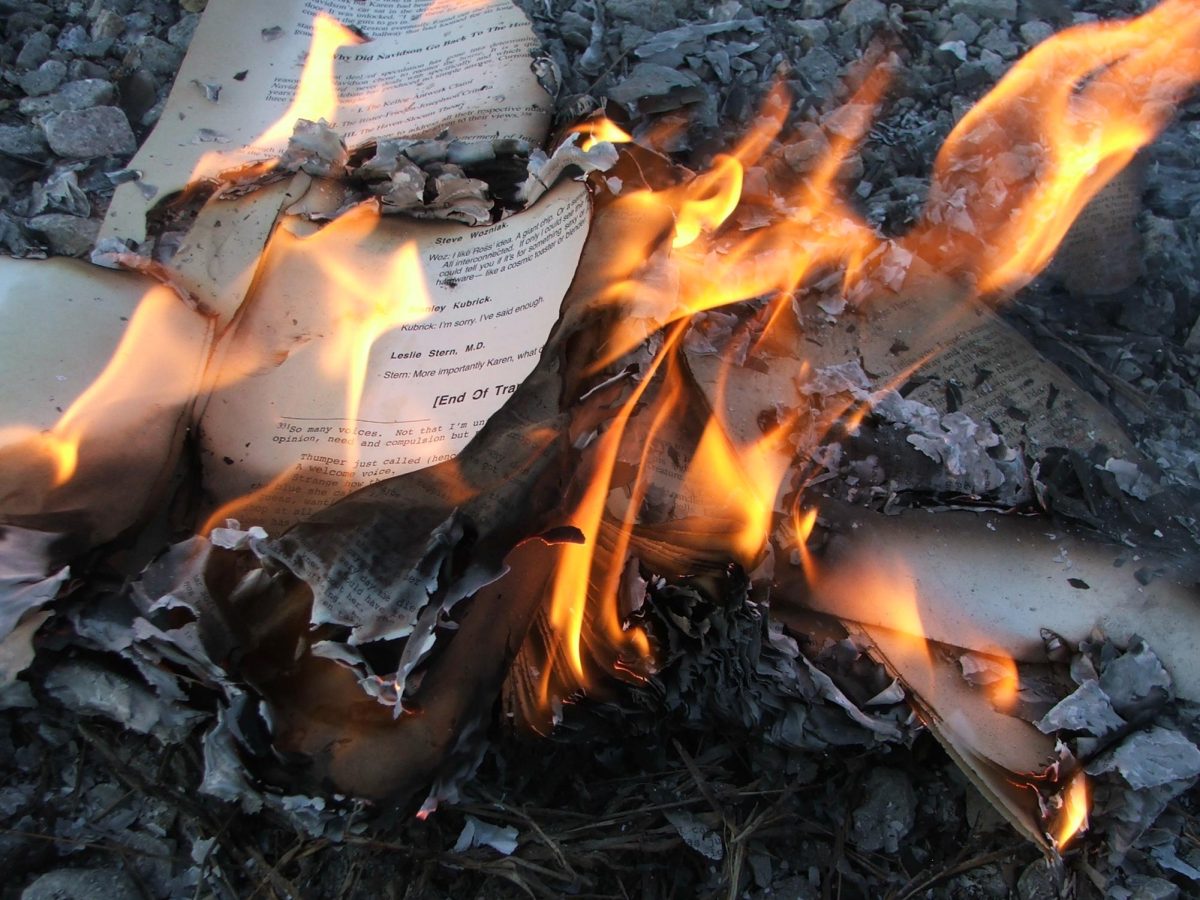
451 degrees Fahrenheit. A number plucked from the air, not because of the way it looks on the printed cover of a novel, but because it is the temperature at which knowledge ceases to be. At which visionaries are silenced. At which books burn.
Ray Bradbury’s 1953 novel “Fahrenheit 451” introduces a bleak dystopia that has become a haunting reflection of our current world, one in which misinformation, forced compliance and the erasure of knowledge have made Bradbury’s cautionary tale something far more than a prediction—it has become reality.
“Fahrenheit 451” follows Guy Montag, a fireman in a world where firemen don’t put out fires, but start them. Montag and his colleagues have been tasked with the crucial job of destroying the most dangerous and threatening contraband in their world—books. Dousing the illegal items, the homes of their possessors and sometimes even the book owners themselves in flames, Montag has never questioned his assignment.
One day, Montag meets a 17-year-old girl named Clarisse, a gentle girl in awe of nature and life in a way that is seemingly nonexistent in their reality. As his meetings with Clarisse grow more frequent, Montag begins to question the detached monotony of his life, his eyes opening to the superficial nature of their existence—an existence in which people’s living room walls are giant screens projecting fictional families; television shows provide watchers with predictable scripts; the masses wear ear buds that project a constant stream of stimulation to prevent time for free thought; and those looking for any semblance of excitement do so by speeding down roads, uncaring for those they hurt.
When Clarisse is struck and killed by one such speeding car, Montag’s grip on his life and obligations begins to slip. In an effort to subtly fight back against the overwhelming power that dictates his life, Montag begins to steal books, saving them from burning and hiding them within his home. The sudden influx of knowledge is dizzying to him, and when he begins to neglect his work, his fire chief, Beatty, visits his home with the damning proclamation that Montag had been caught.
Beatty shares the truth of their calling with Montag—why books must burn. Once, books contained strong, uncensored opinions that led to the upset and offense of certain minorities and special-interest groups. To prevent any such offending, books were simplified until they could hurt no one at all and authors attempted to remove controversy from their writings. When even this proved too offensive, the edict to burn them all was declared. The only way, Beatty revealed, to prevent the masses from being subjected to conflicting opinions was to outlaw them all.
Beatty leaves with a final warning to Montag to destroy the books he has taken, and when he does not, his own wife turns him in to the firemen. Beatty forces Montag to burn his own home, yet when he attempts to arrest Montag, Montag turns his flamethrower on Beatty and flees.
On the run and pursued by a fearsome beast known as the Mechanical Hound, Montag escapes the city, where he meets a group of rebellious book lovers. The men are part of a nationwide network of readers dedicated to preserving as many books as they can, each member memorizing priceless lines of literature in the hopes of one day putting it back to paper and recreating what was lost.
The novel ends with a bomb destroying the city that Montag has narrowly escaped, the consequence of a war ignored by those without the capacity for independent thought. Montag and his new allies resolve to reach the remnants of the ruined city and search for those who survived.
Terrifyingly accurate, “Fahrenheit 451” is a must-read in our current world. Bradbury paints a picture—70 years too soon—of a world not unlike ours, distinguished only by the fact that, to modern-day readers, the tyranny within his novel should be obvious to its prisoners.
It is true that books are not illegal in our country; they are not burned by any mandate. Yet book bannings have occurred for decades, if not centuries, those horrified by an opinion other than their own silencing those they disagree with. This is more real, and more prevalent, than many realize today.
Bradbury initially grasps his audience with rich metaphors and larger-than-life dystopias, but keeps them engaged with eerie depictions of a society enslaved, unable to think for themselves or disagree with the opinions of those on high. As a reader, you want to scream at the characters who favor their digital families over their real ones, who betray their spouses for daring to think differently, who burn people for seeking knowledge.
But look around. Everything he depicts is happening today, just far more subtly than words on a page, being illegal and firemen burning the world down. At its heart, “Fahrenheit 451” isn’t about all of that—not really.
It’s about those who don’t take the time to further their own knowledge, trusting that those in command are always telling the truth. It’s about the masses that would rather let an artificial intelligence summarize books than read the novels themselves, robbing a generation of their critical thinking skills and leaving them gullible, ignorant and susceptible to the control of others.
It’s about people being so afraid of a different opinion that they’d rather obliterate all individuality than accept that we all have the right to what we think (and honestly, the world is so much more beautiful and worthwhile when we can allow ourselves to be different—when we accept that different is okay).
Bradbury’s work matters now more than ever, and I urge everyone to take the time to read “Fahrenheit 451.” Not SparkNotes, not an AI summary, not a movie adaptation. Every time someone chooses to turn away from a novel like this, Bradbury’s dystopia takes another step toward reality. This book, truly, should be on everyone’s list of books to read within their lifetime.
“The problem in our country isn’t with books being banned, but with people no longer reading. You don’t have to burn books to destroy a culture. Just get people to stop reading them,” Bradbury said in response to “Fahrenheit 451.”