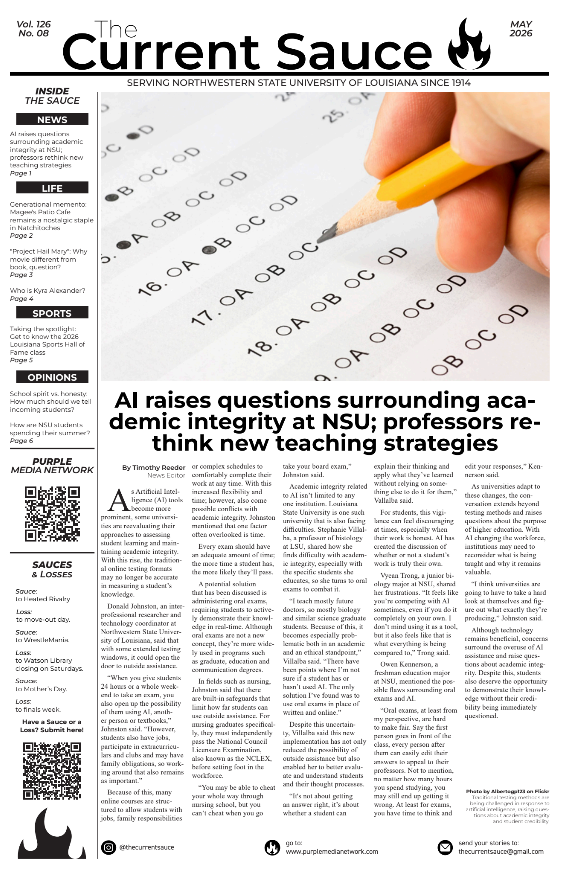





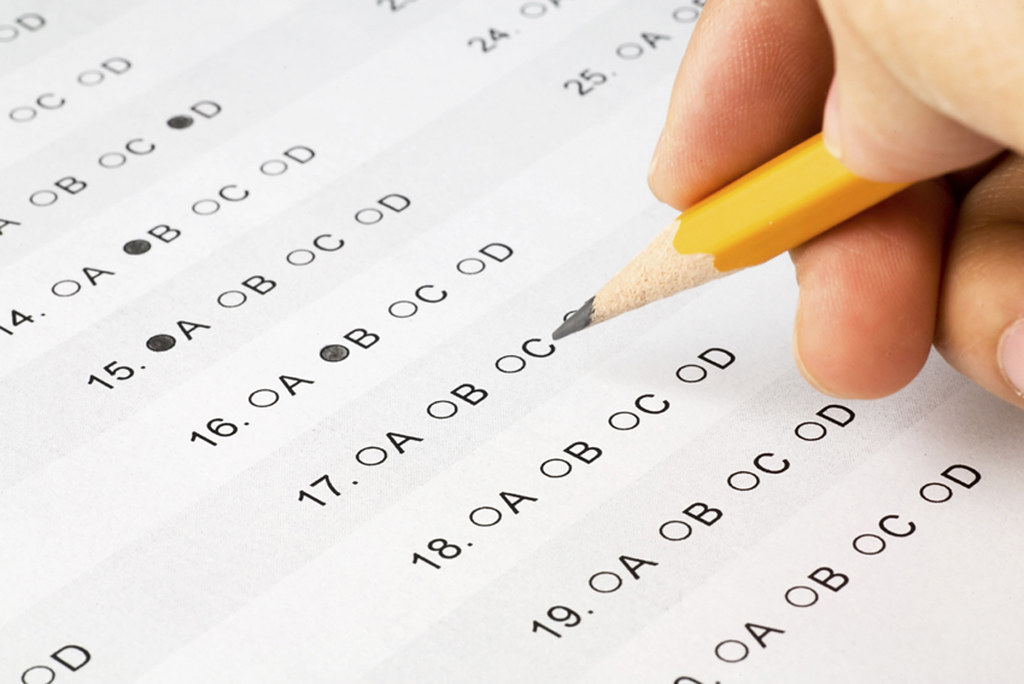
As Artificial Intelligence (AI) tools become more prominent, some universities are reevaluating their approaches to assessing student learning and maintaining academic integrity. With this rise, the traditional online testing formats may no longer be accurate in measuring a student’s knowledge.
Donald Johnston, an interprofessional researcher and technology coordinator at Northwestern State University of Louisiana, said that with some extended testing windows, it could open the door to outside assistance.
“When you give students 24 hours or a whole weekend to take an exam, you also open up the possibility of them using AI, another person or textbooks,” Johnston said. “However, students also have jobs, participate in extracurriculars and clubs and may have family obligations, so working around that also remains as important.”
Because of this, many online courses are structured to allow students with jobs, family responsibilities or complex schedules to comfortably complete their work at any time. With this increased flexibility and time; however, also come possible conflicts with academic integrity. Johnston mentioned that one factor often overlooked is time. Every exam should have an adequate amount of time; the more time a student has, the more likely they’ll pass.
A potential solution that has been discussed is administering oral exams, requiring students to actively demonstrate their knowledge in real-time. Although oral exams are not a new concept, they’re more widely used in programs such as graduate, education and communication degrees.
In fields such as nursing, Johnston said that there are built-in safeguards that limit how far students can use outside assistance. For nursing graduates specifically, they must independently pass the National Council Licensure Examination, also known as the NCLEX, before setting foot in the workforce.
“You may be able to cheat your whole way through nursing school, but you can’t cheat when you go take your board exam,” Johnston said.
Academic integrity related to AI isn’t limited to any one institution. Louisiana State University is one such university that is also facing difficulties. Stephanie Villalba, a professor of histology at LSU, shared how she finds difficulty with academic integrity, especially with the specific students she educates, so she turns to oral exams to combat it.
“I teach mostly future doctors, so mostly biology and similar science graduate students. Because of this, it becomes especially problematic both in an academic and an ethical standpoint,” Villalba said. “There have been points where I’m not sure if a student has or hasn’t used AI. The only solution I’ve found was to use oral exams in place of written and online.”
Despite this uncertainty, Villalba said this new implementation has not only reduced the possibility of outside assistance but also enabled her to better evaluate and understand students and their thought processes.
“It’s not about getting an answer right, it’s about whether a student can explain their thinking and apply what they’ve learned without relying on something else to do it for them,” Vallalba said.
For students, this vigilance can feel discouraging at times, especially when their work is honest. AI has created the discussion of whether or not a student’s work is truly their own.
Vyean Trong, a junior biology major at NSU, shared her frustrations. “It feels like you’re competing with AI sometimes, even if you do it completely on your own. I don’t mind using it as a tool, but it also feels like that is what everything is being compared to,” Trong said.
Owen Kennerson, a freshman education major at NSU, mentioned the possible flaws surrounding oral exams and AI.
“Oral exams, at least from my perspective, are hard to make fair. Say the first person goes in front of the class, every person after them can easily edit their answers to appeal to their professors. Not to mention, no matter how many hours you spend studying, you may still end up getting it wrong. At least for exams, you have time to think and edit your responses,” Kennerson said.
As universities adapt to these changes, the conversation extends beyond testing methods and raises questions about the purpose of higher education. With AI changing the workforce, institutions may need to reconsider what is being taught and why it remains valuable.
“I think universities are going to have to take a hard look at themselves and figure out what exactly they’re producing,” Johnston said.
Although technology remains beneficial, concerns surround the overuse of AI assistance and raise questions about academic integrity. Despite this, students also deserve the opportunity to demonstrate their knowledge without their credibility being immediately questioned.