








Minneapolis, Minn., has recently been a site of political violence. The killings of several Americans by United States Immigration and Customs Enforcement (ICE) agents have sparked a complex nationwide conversation about human rights. Protests on college campuses play an important role in this discussion. University students are leading a call for change around the nation, and some Louisiana campuses are seeing more political activism.
So far, Northwestern State University of Louisiana has stayed quiet on these issues. While there has been ICE activity in Natchitoches, there have been no reports of NSU students being detained. We have also not had any public demonstrations against ICE or for any other cause since the Me Forking Too Survivor’s Walk in 2023. In fact, NSU’s only active recognized student organization with political leanings is our chapter of Turning Point USA, which was approved in November 2025. According to an article written by The Current Sauce, the organization states that they support free speech in all of its forms. They are aligned with conservative values.
At the time of publication, six Louisiana universities have been sites of political protest in 2026. This includes demonstrations against ICE at Louisiana State University, Southeastern Louisiana University, Xavier University, Tulane University and Loyola University, as well as a demonstration against Turning Point USA at Nicholls State University.
Rayven Benton, a sophomore music performance major, said NSU should not follow the example of these other institutions, and is anxious about the presence of political organizations on-campus. “It fans the embers of political tension,” Benton said. “Ideally, we wouldn’t need organizations like that because SGA is supposed to represent our interests.”
Anxiety about political conversations at NSU may be related to incidents on other campuses. Political activism on college campuses has the potential to make targets out of students, as seen at Columbia University where students and faculty were arrested during a protest, according to the New York Times.
Nonetheless, the student protesters sent a clear and necessary message—they were fighting to make Columbia a “sanctuary campus” for students of varying immigration statuses. Although the protest was risky, this change would make a major difference for student safety, and the potential benefit was seen to outweigh the danger.
While there are concerns that arise from a politically active campus, there are also opportunities for positive change. Some believe that it is through these dangerous decisions that the status quo is challenged.
“I feel like I have a right to protest. I am very open about my politics … we have to start a discussion about it,” Michael Mumphrey, a freshman theater major, said.
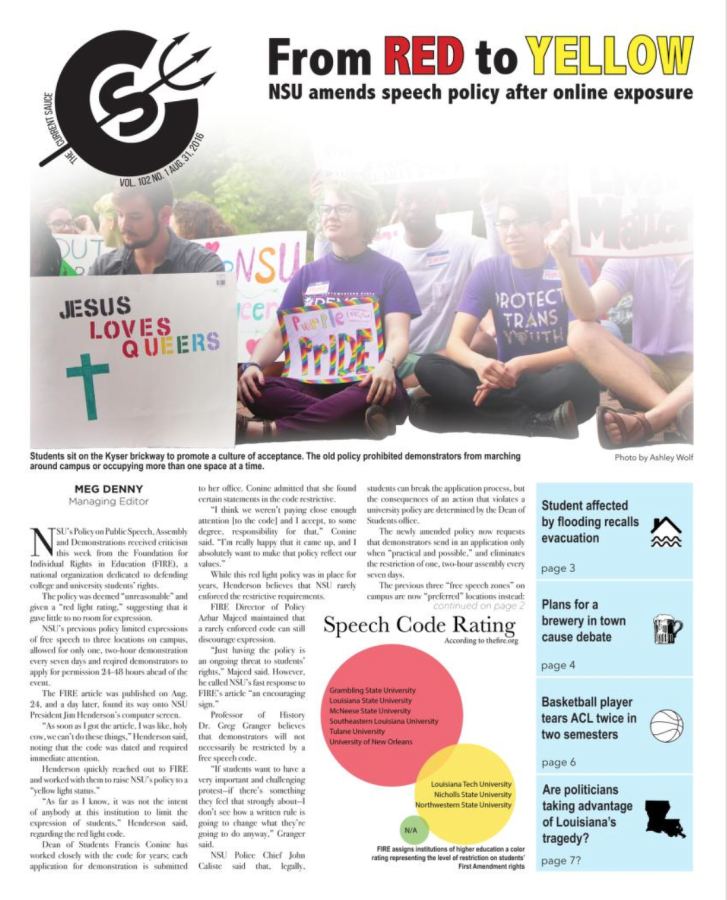
NSU places no restriction on political demonstrations, so long as they remain respectful. Sections 4.1 and 4.2 of the Student Code of Conduct state, “Students shall be free to examine and discuss all questions of interest and to express opinions” and “Students shall be free to support any causes by lawful means.” However, there are also clauses prohibiting the “disruption of a university activity or event” and “disruption of a class or curricular activity” in sections 2.2.2 and 2.2.3. So, while students are allowed to organize protests, they must be carefully executed so as to not disturb the usual activities on-campus.
However, in the wake of the deaths in Minneapolis, many people are hesitant to protest or announce their political views publicly due to physical safety concerns. It is the unfortunate reality that some people will act violently if they feel that their views are threatened. Thus, some argue it is safer to keep quiet about politics altogether.
“A neutral campus is a safe one. If this continues, I fear for the safety of myself and other students,” Violet Hawkins-Fisher, a freshman liberal arts major, said.
Safety is of the utmost importance on-campus. However, the complicated state of our nation requires us to ask ourselves what we think matters most. Should we sacrifice our comfort to speak up for what we believe in? Some believe that a “business as usual” mindset can quickly turn into ignorance.
“Speaking out is really scary,” Mumphrey said. “You don’t really know how people are going to react. Doing the right thing can make you lose something, you will end up having to sacrifice something.”
NSU is a diverse campus with students from many different demographics. We need to stand up for those who are different from us. While silence can grant safety up to a point, there are some people who are in vulnerable positions regardless of how vocal they are. Those who can maintain an illusion of “safety” during these trying times have a duty to defend those who cannot.
No matter what side of the political spectrum you are on, we each have a sense of what is right and wrong. Every voice deserves respect. Political conversations make some people anxious, and often for valid reasons; however, it is also true that anxiety prevents change. The state of our world necessitates open conversations about our beliefs.